

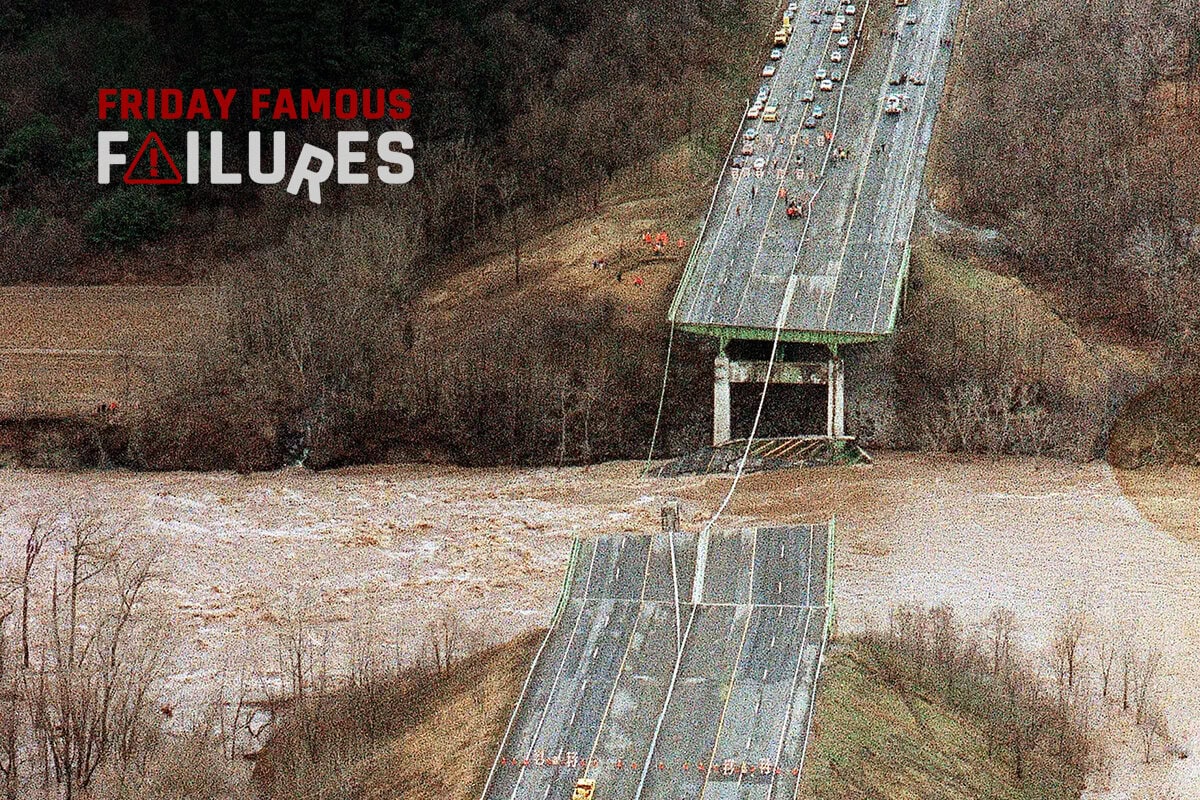
Date: April 5, 1987
Location: Schoharie Creek, New York, USA
Fatalities: 10
Injuries: None reported (all victims were fatalities)
Estimated Economic Impact: Tens of millions of dollars in emergency response, bridge replacement, traffic disruption, litigation, and nationwide inspection and retrofit programs
On April 5, 1987, the Schoharie Creek Bridge on the New York State Thruway (I-90) collapsed during a severe spring flood, sending multiple bridge spans into the creek below. Five vehicles plunged into the water, resulting in the deaths of ten people. The bridge had been in service for nearly 30 years and carried one of the busiest transportation corridors in New York State.
The Schoharie Creek collapse is a defining case study in hydraulic scour, foundation design assumptions, and the limits of historical engineering practice. Unlike failures caused by overload, fatigue, or material degradation, this disaster was driven by a mechanism that was poorly understood at the time of design but is now recognized as one of the leading causes of bridge failure worldwide.
Background: Bridge Design and Site Conditions
The Schoharie Creek Bridge was completed in 1954 and consisted of a series of simply supported steel girder spans resting on reinforced concrete piers. The piers were founded on shallow spread footings embedded directly into the streambed and protected by shallow riprap.
At the time of design, prevailing engineering practice assumed that local scour around bridge piers would be limited and self-arresting, particularly in streams with coarse bed material. Deep foundation elements such as piles or drilled shafts were not used. Instead, designers relied on the assumed stability of the streambed and the presence of riprap to prevent erosion.
Schoharie Creek drains a large watershed in upstate New York and is subject to rapid runoff during snowmelt and heavy rainfall events. However, historical flood data available during design did not indicate the extreme hydraulic conditions that would ultimately occur in April 1987.
What Caused the Failure?
The collapse of the Schoharie Creek Bridge resulted from a convergence of hydraulic forces and design assumptions that left the structure vulnerable during extreme flood conditions. Official investigations identified the following primary causal factors:
- Severe local scour at pier foundations during extreme flooding
- Use of shallow spread footings without deep foundation elements
- Design assumptions that underestimated maximum scour depth
- Lack of inspection and monitoring focused on foundation exposure
Each of these factors contributed directly to the loss of structural support at critical bridge piers.
Severe Local Scour at Pier Foundations During Extreme Flooding
The immediate physical cause of the bridge collapse was severe local scour at several pier foundations during record flood conditions. As floodwaters rose, flow velocities around the piers increased dramatically, generating strong horseshoe vortices at the base of the foundations. These vortices removed streambed material at a rate far exceeding typical erosion processes.
Post-collapse investigations determined that scour depths during the flood were significantly greater than the embedment depth of the pier footings. Once the supporting soil was removed, the affected pier lost both vertical bearing capacity and lateral stability. Even partial undermining was sufficient to induce rotation and displacement of the pier under normal service loads, triggering the collapse sequence.
Use of Shallow Spread Footings Without Deep Foundation Elements
The Schoharie Creek Bridge piers were founded on shallow spread footings placed directly within the streambed. While consistent with design practices of the early 1950s, this approach provided little tolerance for unexpected erosion.
Unlike piles or drilled shafts, shallow footings rely entirely on near-surface soil for support. When scour removed that soil, there was no alternative load path to transfer forces to deeper, more competent material. The structural superstructure remained largely intact; it was the loss of foundation support that precipitated failure. The bridge did not fail because it was overloaded, but because its foundations were no longer supported by the ground beneath them.
Design Assumptions That Underestimated Maximum Scour Depth
At the time of design, the engineering profession lacked reliable analytical tools to predict maximum scour depth under extreme hydraulic conditions. Designers assumed that scour would be limited, self-stabilizing, and adequately controlled by riprap protection and the coarse nature of the streambed.
Modern hydraulic modeling and empirical scour equations, now standard in bridge design, did not exist. As a result, the foundations were not designed to remain stable under worst-case flood scenarios. The Schoharie failure revealed a critical gap between historical design assumptions and actual river behavior, particularly during rare but high-consequence flood events.
Lack of Inspection and Monitoring Focused on Foundation Exposure
Inspection practices at the time of the collapse emphasized visible elements of the bridge, such as the superstructure and exposed portions of the substructure. Little attention was given to conditions below the waterline, where the most critical deterioration was occurring.
There was no routine underwater inspection program capable of detecting progressive scour, nor were there instruments in place to monitor streambed elevation or foundation exposure during flood events. Consequently, the bridge remained open to traffic even as its load-bearing foundations were being undermined. The absence of real-time monitoring or defined closure criteria based on hydraulic conditions allowed the failure to occur without warning.
Engineering Lessons
The Schoharie Creek Bridge failure fundamentally reshaped engineering understanding of hydraulic scour and foundation vulnerability.
Scour is now treated as a primary design load case rather than a secondary consideration. Modern bridge design standards require explicit evaluation of worst-case scour depths and foundation stability under extreme flow conditions.
Deep foundations such as piles or drilled shafts provide resilience by transferring loads to deeper, more stable soil layers. Where shallow foundations are used, embedment depths must exceed predicted maximum scour with appropriate safety margins.
Equally important, inspection programs must address hidden failure modes. Routine underwater inspections and scour evaluations are now standard practice, recognizing that the most critical damage may occur out of sight long before visible distress develops.

 1431 Graham Drive, Suite 265
 support@noonpi.com

I do not disagree with the conclusion that this bridge failure resulted from a loss of foundation support due to hydraulic scour. However, I would suggest that the root cause may be more appropriately attributed to insufficient inspection, monitoring, and maintenance over the life of the structure.
The bridge had been in service for approximately 30 years. While the original design may have reflected the limitations of engineering practice at the time, subsequent advances in hydraulic analysis and scour prediction methods had, by then, provided improved tools for evaluating potential risks under extreme conditions. This raises the question of whether those risks could have been identified and mitigated through periodic reassessment of the structure.
In this context, responsibility may extend beyond the original design to include the entities responsible for ongoing bridge management, inspection, and maintenance. These functions play a critical role in ensuring long-term structural integrity, particularly where evolving knowledge and environmental conditions may challenge the assumptions made during initial design.
I agreed with the comments
I also disagree with the conclusion provided for the collapse of the bridge, while I agree with the fact that the collapse occurred because of a spread footing foundation in a water stream.
The design was provided by one of the predecessor firms of URS, now part of AECOM. I was employed by URS from 1994 until 2006 as their Director of Quality Management with a back ground of bridge design and bridge design management.
The information I have and used in my quality training sessions within URS is as follows.
URS or one of its predecessors provided the design to the bridge owner, the New York State Thruway Authority, as mentioned in the early fifties. It can indeed be concluded that if the bridge had been designed as it was built in 1954, the design would have been inadequate to current and to standards at the time of design. Therefore URS was sued based on professional liability. This was possible after thirty years because New York State does not have statutes of limitations. For this reason URS had and still has its design records retained forever. URS was able to retrieve the design records of the Schoharie River Bridge and to demonstrate that the foundation as designed was not a spread footing but a foundation on steel piles. While this would have prevented the collapse due to scour, the designer recognized the risk of scour and mitigated this risk not just with a pile foundation but with an additional sheet pile protection around the pile cap. URS was subsequently released from any further legal proceedings. During construction it was decided to save money and to eliminate the sheet pile scour protection and pile foundation.
The lessons I taught at URS were the following:
1. Be extremely careful during the construction phase of a project with any deviations from the design without engaging the Engineer of Record (think also of the collapse of a floor in the new Hyatt Hotel in Kansas City, killing many guests, due to inconsistencies between the design and shop drawings).
2. Avoid designs of statically determined structures (easier to design) and prefer statically indetermined structures, that have more than one possible load path, which may prevent collapse in case of a failure.
3. If you design structures in the State of New York, make sure you retain good records forever because professional liability suits can be brought forever.
I think William Xia’s comments on March 27, 2026, was spot on. As we gain better understanding of how infrastructure interact with the environment and the events of naturally occurring environmental disasters, design codes must evolve and existing structures must be assessed against such changes to ensure that they are indeed still in compliance with current codes. Another good example and one that is even more critical is seismic retrofitting in earthquake prone regions such as California and strengthening of buildings in areas prone to major hurricanes as in Florida. The agencies responsible for operating and maintaining infrastructure in the regions that are prone to such disasters must continue to carry out the due diligence required to preserve the life and maintain the functionality of the nation’s infrastructure.
Please read and re-read Mr. Schor’s comments thoroughly. Major emphasis: The bridge piers were not built as originally designed, but reduced from pile supported with additional protection against scour to a simple and obviously too shallow spread footing to save money. If it had been built as originally designed there would have been no failure. Use of simple spans instead of continuous spans was not a factor in the failure. Whether named so at the time, changes for the sake of changing money, that is “Value Engineering” can have dangerous unintended consequences, and many more times have resulted in a saving of $10 now that will cost $100+ later to repair or replace. “El cheapo” designs that will come back to bite you later can also be a major problem with design-build works.
Need edit to my above comment: “Changes for the sake of changing money” Should obviously have been “changes for the sake of saving money”
I certainly agree with the idea that for systems and structures, such as bridges and elevated roadways for example, with performance and safety of obvious extreme importance to human life, should forever be under reasonable scrutiny to assess performance condition. There is of course a continual change in knowledge, technology, materials, environment, and extent of usage; and significant errors can occur. And of course, the best of materials can often decay more rapidly than expected.
It is a bit troubling that there are important failures that very difficult to assess and predict, and often prohibitively expensive to assess or replace. Concrete failure is a prime example of this, and we have had notable examples of this in the failure of suspension bridges, in which the cyclic stresses in the concrete road surface eventually results in fractures. The state of this kind of damage is difficult to monitor and assess. There are efforts to include stress sensors in the concrete to
help monitor this problem.
All told, we of course have a balancing problem in management of human safety. It is simply not possible to perfectly manage our technology world to avoid all danger, and some danger is à price we pay for the environment we want. Most humans know that. But clearly we can do better by paying more attention.