

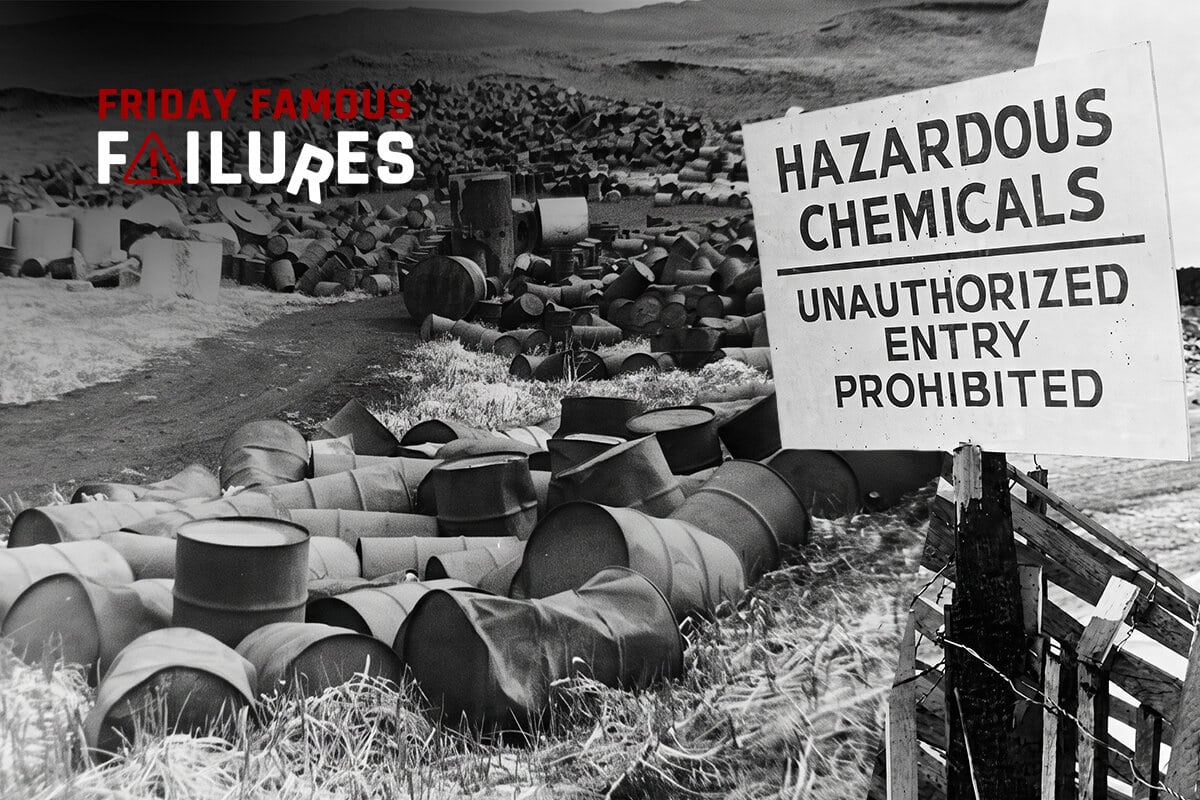
Date: Public crisis emerged in 1978
Location: Former Love Canal hazardous-waste landfill and surrounding neighborhood near Niagara Falls, New York
Outcome: Hundreds of families relocated; homes and schools demolished or restricted
Primary failure mechanism: Migration of buried hazardous chemical waste into surrounding soil, groundwater, sewers, basements, and occupied areas
Love Canal did not fail in a single moment. There was no explosion, roof collapse, or structural fracture that immediately revealed the disaster. Instead, the failure developed over decades as buried chemical waste migrated from an abandoned canal into a residential neighborhood built around and near the disposal area.
For engineers, that is what makes Love Canal so important. It was a disaster of containment, land-use planning, environmental investigation, institutional memory, and long-term risk management. The immediate hazard was chemical exposure. The deeper failure was the assumption that covering hazardous waste with soil and moving on would be adequate protection for future occupants.
By the late 1970s, residents of the Love Canal neighborhood were reporting chemical odors, residues, contaminated sump water, damaged vegetation, and health concerns. State and federal agencies investigated. Homes were evacuated. Schools and houses were demolished. The site became one of the defining events that led to the federal Superfund program.
A Canal That Became a Dump
Love Canal began as an unfinished nineteenth-century development project. William T. Love had proposed a canal that would support hydroelectric power and a planned community near Niagara Falls. The project was abandoned, leaving behind a partially excavated trench.
That abandoned excavation later became a disposal site. Between 1942 and 1953, Hooker Electrochemical Company used the canal to dispose of more than 21,000 tons of hazardous chemicals. The waste was placed in a makeshift landfill, later covered with soil. In 1953, the covered landfill area was transferred for public use, and a school and homes were later built near or around the former disposal area.
From a modern engineering standpoint, the risk is obvious. A hazardous-waste landfill requires durable containment, hydraulic control, monitoring, institutional controls, and restrictions on incompatible future land use. Love Canal had none of those protections in the form that would later become standard practice. The site was treated as if burial and surface cover were enough.
They were not.
A Neighborhood Built Over Risk
For years, Love Canal functioned as a working-class residential neighborhood. Families bought homes, children attended school, and the buried waste remained largely out of sight. But containment by concealment is not containment.
The problem was not just that chemicals existed underground. The problem was that the disposal area interacted with natural and built systems: groundwater, precipitation, soil, storm sewers, sanitary sewers, basements, sump systems, and surface drainage. As water levels rose and drums deteriorated, contaminants migrated. Chemical residues appeared in yards, basements, school grounds, and drainage pathways.
Residents reported odors, oily residues, damaged gardens, blackened vegetation, and chemical seepage. Some described children returning from play with burns or rashes. Public health concerns grew around miscarriages, birth defects, blood abnormalities, and possible long-term chemical exposures. The scientific and legal evaluation of health effects was complex, but the engineering reality was direct: hazardous materials had not remained isolated from people.
What Caused the Failure?
Love Canal was caused by a chain of failures rather than one isolated mistake.
The first failure was disposal. Hazardous chemical wastes were placed in a former canal excavation that was not engineered as a modern secure hazardous waste landfill. The containment system was inadequate for long-term isolation.
The second failure was land-use control. Schools and homes were built near the former disposal area, placing occupied structures and children near buried industrial waste. The site history was not translated into durable land-use restrictions that protected future residents.
The third failure was hydrologic control. Rainfall, groundwater, deteriorating drums, sewers, sumps, and drainage pathways allowed contaminants to move. A landfill that depends on wastes staying dry and immobile is vulnerable if water can enter, mobilize contaminants, and carry them toward people.
The fourth failure was response. Warning signs existed before the national crisis. Residents complained about odors, residues, and health concerns. But the full seriousness of the problem was not acted on until the contamination had already affected a neighborhood.
More than a Dumping Problem
It would be too simple to describe Love Canal only as irresponsible waste disposal. The disposal was central, but the disaster also involved engineering decisions made after disposal ended.
A buried hazard remains part of the built environment. If future engineers, planners, school boards, utility designers, inspectors, and public officials do not understand or preserve that information, the hazard can be rediscovered by the next generation in the worst possible way.
Love Canal also demonstrated that utilities and civil infrastructure can become contaminant pathways. Sewers, drainage channels, basements, sump pumps, and excavations are not neutral features when placed near contaminated soil and groundwater. They can intercept, redirect, or expose contamination.
The case also changed the national understanding of environmental liability. Before Superfund, the United States lacked a comprehensive federal mechanism to investigate, prioritize, fund, and compel cleanup of abandoned hazardous-waste sites. Love Canal helped create the political and regulatory momentum for that system.
Engineering Lessons
The first lesson is that containment must be designed for time. Hazardous waste may remain dangerous for decades or centuries. A soil cover alone is not a long-term remedy if water intrusion, erosion, development, utilities, or human exposure can compromise the site.
The second lesson is that land-use decisions are part of engineering risk management. A site that may be tolerable as a restricted industrial or containment area may be unacceptable for homes, schools, playgrounds, or basements.
The third lesson is that groundwater and stormwater control matter. Water is often the transport mechanism that turns buried contamination into human exposure. Engineers must understand gradients, infiltration, drainage, pipe defects, sumps, and surface discharge points.
The fourth lesson is that records and institutional controls must survive ownership changes. Future occupants need enforceable restrictions, not merely historical knowledge hidden in files.
The fifth lesson is that community observations are data. Odors, residues, basement seepage, vegetation damage, and repeated health complaints should trigger structured investigation, not dismissal.

 1431 Graham Drive, Suite 265
 support@noonpi.com

I remember this horrible situation that occurred in my youth. It reaffirmed my decision to pursue Environmental Engineering as a profession. We must never forget and do better in the future.
Reason Magazine did an expose on this in the late 1970’s or early 1980’s. As I recall the trench was lined with clay and the property was only sold to the town after the town threatened to take it by eminent domain. And Hooker Chemical had provisions in the sale that the town would not disturb the trench area. The disaster was mostly a political driven one!
I recall the name of the incident, “Love Canal” and I was already a PE or almost a PE. So, I was not ignorant of the situation. But my recollection is minimal. As a kid, I played in and around a slag dump site from a foundry, That dump site is now gone, but who knows what else was dumped there. I also recall another manufacturing site that could not dispose of soil removed from new construction projects. Any soil had to be disposed in an approved manner. I suspect there are probably hundreds of such situations as these throughout this country. And I recall how the whole question of nuclear waste disposal is approached. The Lovev Canal is just one example;
Mr. Loomis is correct, this was a political failure not an engineering failure. My mom was the school nurse at 99th Street School. They subpoenaed her health records and disposed her for several of the legal actions. Don’t disagree attempting to dispose of nerve agents, dioxin, and other hazardous materials in an abandoned, partially built canal that empties into the upper Niagara River above the fresh water intakes for the City is not acceptable. I also don’t disagree that it took a lot of ignorance and stupidity to build houses and a school on the clay cap.
As a NYC Resident I remember hearing about “Love Canal” when I was in High School and going into college. At the time I did not fully understand / keep up with the issue / problem. However, after seeing a story on PBS several years ago and working for an Environmental Engineering firm (not directly involved in hazardous waste) I really saw what was going on. If I recall correctly the NYS Government was downplaying the situation. At the time many women still stayed home to raise the family while the man went to work. I believe this was the site where the women of the community organized and pushed the NYS government to investigate and take action, thus the Federal Government got involved. On projects I do come across hazardous waste such as lead paint, PCBs (mainly in electrical transformers and or ballasts), mercury, etc. Current regulations put the site owner as the entity responsible for clean up and disposal from the cradle to the grave so to speak. On the Municipal Projects I work on laws are adhered to. Love Canal demonstrates what happened in the Wild West days of Hazardous Waste.
Love Canal definitely influenced me in my environmental activism and eventual career. Seems like every community has their own Love Canal. Here in New Jersey, I’m not sure if folks remember the Toms River contamination crisis. The Ciba-Geigy Corporation illegally dumped industrial chemical waste from 1952 through the 1980’s. Millions of gallons of toxic effluent from the dye and resin were discharged into the river. They actually built a 10-mile pipeline to pump waste into the Atlantic Ocean. Tens of thousands of chemical drums were buried in unlined pits on the 1400-acre site creating a massive plume of polluted groundwater leaching into public drinking water wells. A childhood cancer cluster was the result. Declared an EPA Superfund Site in 1983. Interesting book on the subject, “Toms River: A Story of Science and Salvation”.
In the 1970’s there were people who considered environmental regulations unlawful government controls, restricting their rights to dispose of hazardous chemicals and garbage by dumping in public waterways and destroying nature as they pleased. Rivers and lakes were sometimes strange colors and devoid of fish and life. Some people saw now problems with this and thank God other’s realized how important it is to care for our fragile planet. River’s and harbors recovered somewhat but never fully. The really sad part is we are now reverting to such thinking. Many think it’s okay to destroy the nature we all need, to so the wealthy can purchase bigger yachts. Wake up people!