
This is the May 2026 edition of our monthly series of Ethics case studies titled What Do You Think? This series is comprised of case studies from NSPE archives, involving both real and hypothetical matters submitted by engineers, public officials and members of the public.
Your peers and the NSPE Board of Ethical Review have reviewed the facts of the case as shown below. And, here are the results.
Your opinion has been registered for the May 2026 edition of our monthly series of Ethics case studies titled What Do You Think?
Your vote is recorded as:

Want to know how your peers voted? We’ll send you an email with the poll results on May 26.
Your opinion has been registered for the May 2026 edition of our monthly series of Ethics case studies titled What Do You Think?
Your vote is recorded as:

Want to know how your peers voted? We’ll send you an email with the poll results on May 26.
A Review of the Facts
A local county ordinance requires that the position of county surveyor be filled by a P.E. The first appointee to the position was not a P.E. and was therefore deemed unqualified to continue in the position. The county commissioners met and decided to appoint Engineer Ted, a P.E. with experience and educational background solely in the field of chemical engineering. Engineer Ted accepted the position.
The duties and responsibilities of the position of county surveyor include oversight of surveying reports and highway improvement projects but do not include actual preparation of engineering or surveying documents.
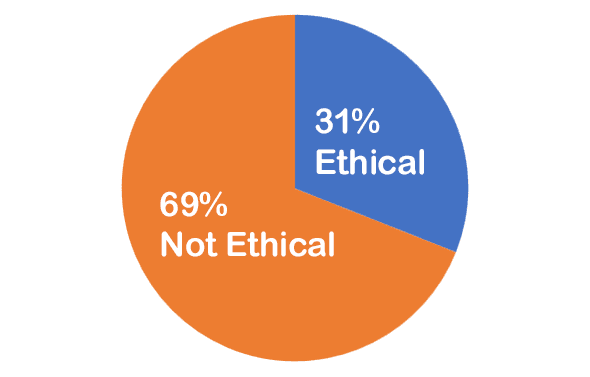
Was it ethical for Engineer Ted to accept the position of county surveyor?
Here is the result of our survey of your peers:
Applicable NSPE Code References:
Code II.2: Engineers shall perform services only in the areas of their competence.
Code II.2.a: Engineers shall undertake assignments only when qualified by education or experience in the specific technical fields involved.
Code II.2.b: Engineers shall not affix their signatures to any plans or documents dealing with subject matter in which they lack competence, nor to any plan or document not prepared under their direction and control.
Code II.2.c: Engineers may accept assignments and assume responsibility for coordination of an entire project and sign and seal the engineering documents for the entire project, provided that each technical segment is signed and sealed only by the qualified engineers who prepared the segment.”
Discussion
The Board notes that its evaluation of the facts of this case is limited to an interpretation of the NSPE Code of Ethics and in no way constitutes an interpretation of any state engineering or surveying registration law in recognition of the great disparity in state registration laws and rules of professional conduct.
The Code provisions under consideration in the case have been interpreted in the past by this Board in the context of consulting engineering services and not in the context of an employment relationship.
Obviously, there are important distinctions in applying the Code language to a consulting practice and applying the language in the context of an employment relationship. In the former situation, the firm has a good deal more discretion and flexibility and may be able to structure its work force to fit the needs and requirements of a particular job for which the firm is being retained. For example, if an engineering firm is retained to perform engineering and land surveying services and the firm does not have expertise in the area of land surveying, under the provisions of the Code the firm should retain individuals with that expertise. Because of the relatively dynamic nature of private consulting practice, engineering firms frequently establish joint ventures and subcontracts, hire additional qualified personnel, or make other arrangements in order to serve the needs of a client more effectively and efficiently.
However, in the instant situation, from a practicality standpoint, it would be extremely difficult, if not impossible, for a county surveyor with no background or expertise in surveying to perform effective oversight of surveying reports and highway improvement projects for the county. We do not see any way in which Engineer Ted could be in accordance with Code II.2.b. under these facts because whatever course of action he took would result in unethical conduct and compromise his role as county surveyor. It may seem plausible that Code II.2.c. would provide some ethical avenue through which Engineer Ted could perform the job as county surveyor.
While it is true that Engineer Ted meets the legal requirements for the position because he is a licensed professional engineer, professional ethics requires an engineer to go beyond what is specifically permitted by the law. For example, it may be legal for an engineer to exercise his First Amendment rights by making strong and critical statements with regard to another individual or with respect to a particular public policy issue; however, it is an entirely different question as to whether such conduct would be ethical under those circumstances. We are of the view that the same reasoning would apply to this particular case.
Because of the absence of a case relating to the instant facts, we must look to the Code of Ethics and apply its language to the facts at hand. In Code II.2, the introductory section makes the clear statement that the engineer is obligated to perform services only in his area of competence. We do not think it would be consistent with the Code provision for Engineer Ted to act as a county surveyor when his expertise is limited to the field of chemical engineering. Code II.2a. states that the engineer should undertake assignments only when qualified by education or experience in the specific technical fields involved. Again, the position that Engineer Ted is accepting is in an area in which he possesses no apparent expertise. Under the facts of this case, the job responsibilities of the county surveyor do not include actual preparation or approval of engineering or surveying documents; however, the job responsibilities do include oversight of surveying reports and highway improvements. Such oversight is important in protecting the interests of the public and must be performed by one with expertise and background in the areas of surveying and highway improvements.
It could be stated that Engineer Ted’s responsibilities did not include actual preparation or approval of engineering or surveying documents, that instead such documents would be prepared or approved by qualified individuals, and that Engineer Ted’s role would be to oversee those documents and reports. We are convinced that neither is this the intent of the Code provisions nor is this what is commonly understood to be the proper oversight role of a county surveyor.
First, Code II.2.c. must be read in the context of the other provisions that precede it and that relate to the ethical requirement that one should not perform services in areas where one lacks competence. Second, at a bare minimum, we think that one who is serving in the role as a county surveyor must have at least some substantive degree of background and experience in order to accept such a position. We fail to see how an individual, without such background or experience, could properly perform and exercise the judgment and discretion required by the job.
The Ethical Review Board’s Conclusion
It was unethical for Engineer Ted to accept the position as county surveyor.
BOARD OF ETHICAL REVIEW
F. Wendell Beard, P.E. Robert J. Haefeli, P.E. Ernest C. James, P.E. Robert W. Jarvis, P.E. James L. Polk, P.E. Everett S. Thompson, P.E. J. Kent Roberts, P.E., chairman
Note – In regard to the question of application of the Code to corporations vis-a-vis real persons, business form or type should not negate nor influence conformance of individuals to the Code. The Code deals with professional services, which services must be performed by real persons. Real persons in turn establish and implement policies within business structures. The Code is clearly written to apply to the Engineer and it is incumbent on a member of NSPE to endeavor to live up to its provisions. This applies to all pertinent sections of the Code. This opinion is based on data submitted to the Board of Ethical Review and does not necessarily represent all of the pertinent facts when applied to a specific case. This opinion is for educational purposes only and should not be construed as expressing any opinion on the ethics of specific individuals. This opinion may be reprinted without further permission, provided that this statement is included before or after the text of the case.



 1431 Graham Drive, Suite 265
 support@noonpi.com