
This is the June 2026 edition of our monthly series of Ethics case studies titled What Do You Think? This series is comprised of case studies from NSPE archives, involving both real and hypothetical matters submitted by engineers, public officials and members of the public.
Your peers and the NSPE Board of Ethical Review have reviewed the facts of the case as shown below. And, here are the results.
Your opinion has been registered for the June 2026 edition of our monthly series of Ethics case studies titled What Do You Think?
Your vote is recorded as:

Want to know how your peers voted? We’ll send you an email with the poll results on June 23.
Your opinion has been registered for the June 2026 edition of our monthly series of Ethics case studies titled What Do You Think?
Your vote is recorded as:

Want to know how your peers voted? We’ll send you an email with the poll results on June 23.
A Review of the Facts
Engineer Henry is retained by the state to perform certain feasibility studies relating to a possible highway spur. The state is considering the possibility of constructing the highway spur through an area that is adjacent to a residential community in which Engineer Henry’s residence is located. After learning of the proposed location for the spur, Engineer Henry discloses to the state the fact that his residential property may be affected by the new spur and fully discloses the potential conflict with the state. The state does not object to Engineer Henry’s performing the work. Engineer Henry proceeds with his feasibility study and ultimately recommends that the spur be constructed. The highway spur is constructed.
Was it ethical for Engineer Henry to perform the feasibility study despite the fact that his land may be affected thereby?
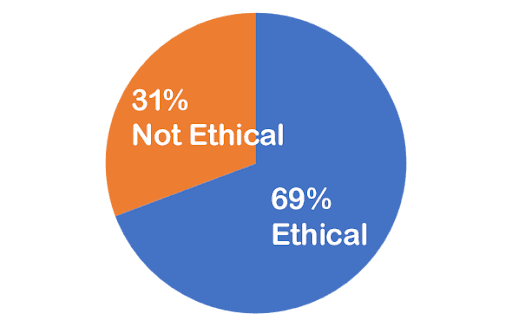
Here is the result of our survey of your peers:
Applicable NSPE Code References:
Code II.4: Engineers shall act for each employer or client as faithful agents or trustees.
Code II.4.a: Engineers shall disclose all known or potential conflicts of interest that could influence or appear to influence their judgment or the quality of their services.
Discussion
This Board has noted on numerous occasions that the ethical duty of the engineer in areas of conflict of interest is to inform the client of those business connections or interests that may influence the judgment and quality of the engineering services. Those decisions have been consistent with the provisions of Code II.4.a. of the NSPE Code of Ethics cited above.
While that provision of the Code has been interpreted many times over the years, it is, as are all Code provisions, subject to constant examination and reinterpretation. For any code of ethics to have meaning, it must be a living, breathing document which responds to situations that evolve and develop.
This Board has generally interpreted that Code provision in a strict manner. However in this case, we are of the view that the ethical obligations contained in Code II.4.a. do not require the engineer to “avoid” any and all situations that may or may not raise the specter of a conflict of interest. Such an interpretation of the Code would leave engineers with neither any real understanding of the ethical issues nor any guidance as to how to deal with the problem. The basic purpose of a code of ethics is to provide the engineering profession with a better awareness and understanding of ethical issues that impact upon the public. Only through interacting with the public and clients will engineers be able to comprehend the true dimensions of ethical issues. We believe that holds true in the area of conflicts of interest.
We add that the Board assumes that under the facts of this case, the state agency involved has a fully qualified staff which will ultimately review the recommendation of the engineer.
Therefore, we are of the view that Engineer Henry’s discussion with the client prior to performing the services and disclosing the possible conflict of interest came within the ethical guidelines of the Code and was a proper course to take in dealing with the conflict. We are not willing to state that the engineer can only avoid such a conflict either by “disposing of his land and holdings prior to undertaking the commission or by declining to perform the services if it is not feasible or desirable for him to dispose of his land at the particular time.” We do not read the current Code to require such action.
The Ethical Review Board’s Conclusion

It was not unethical for Engineer Henry to perform the feasibility study despite the fact that his land may be affected thereby.
BOARD OF ETHICAL REVIEW
F. Wendell Beard, P.E. Robert J. Haefeli, P.E. Ernest C. James, P.E. Robert W. Jarvis, P.E. James L. Polk, P.E. Everett S. Thompson, P.E. J. Kent Roberts, P.E., chairman
Note – In regard to the question of application of the Code to corporations vis-a-vis real persons, business form or type should not negate nor influence conformance of individuals to the Code. The Code deals with professional services, which services must be performed by real persons. Real persons in turn establish and implement policies within business structures. The Code is clearly written to apply to the Engineer and it is incumbent on a member of NSPE to endeavor to live up to its provisions. This applies to all pertinent sections of the Code. This opinion is based on data submitted to the Board of Ethical Review and does not necessarily represent all of the pertinent facts when applied to a specific case. This opinion is for educational purposes only and should not be construed as expressing any opinion on the ethics of specific individuals. This opinion may be reprinted without further permission, provided that this statement is included before or after the text of the case.



 1431 Graham Drive, Suite 265
 support@noonpi.com