

This is the September 2026 edition of our monthly series of Ethics case studies titled What Do You Think? This series is comprised of case studies from NSPE archives, involving both real and hypothetical matters submitted by engineers, public officials and members of the public.
Your peers and the NSPE Board of Ethical Review have reviewed the facts of the case as shown below. And, here are the results.
Your opinion has been registered for the September 2026 edition of our monthly series of Ethics case studies titled What Do You Think?
Your vote is recorded as:

Want to know how your peers voted? We’ll send you an email with the poll results on September 29.
Your opinion has been registered for the September 2026 edition of our monthly series of Ethics case studies titled What Do You Think?
Your vote is recorded as:

Want to know how your peers voted? We’ll send you an email with the poll results on September 29.
A Review of the Facts
Engineer Nick is retained by a city to design a bridge as part of an elevated highway system. Engineer Nick then retains the services of Engineer Steve, a structural engineer with expertise in horizontal geometry, superstructure design and elevations to perform certain aspects of the design services. Engineer Steve designs the bridge’s three curved welded plate girder spans which were critical elements of the bridge design.
Several months following completion of the bridge, Engineer Nick enters the bridge design into a national organization’s bridge design competition. The bridge design wins a prize. However, the entry fails to credit Engineer Steve for his part of the design.
Was it ethical for Engineer Nick to fail to give credit to Engineer Steve for his part in the design?
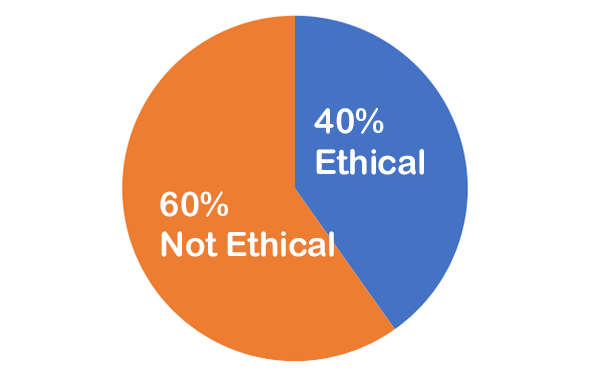
Here is the result of our survey of your peers:
Applicable NSPE Code References:
Code I.3: Issue public statements only in an objective and truthful manner.
Code I.3.a: Engineers shall be objective and truthful in professional reports, statements, or testimony. They shall include all relevant and pertinent information in such reports, statements, or testimony, which should bear the date indicating when it was current.
Code III.3: Engineers shall avoid all conduct or practice that deceives the public.
Code III.5.a: Engineers shall not accept financial or other considerations, including tree engineering designs, from material or equipment suppliers for specifying their product.
Code III.9.a: Engineers shall, whenever possible, name the person or persons who may be individually responsible for designs, inventions, writings, or other accomplishments.
Discussion
Basic to engineering ethics is the responsibility to issue statements in an objective and truthful manner (Code I.3) The concept of providing credit for engineering work to those to whom credit is due is fundamental to that responsibility. This is particularly the case where an engineer retains the services of other individuals because the engineer may not possess the education, experience and expertise to perform the required services for a client. The engineer has an obligation to the client to make this information known (Code II.3.a.). The principle is not only fair and in the best interests of the profession, but it also recognizes that the professional engineer must assume personal responsibility for his decisions and actions.
In BER Case 71-1, a city department of public works retained Firm A to prepare plans and specifications for a water extension project. Engineer B, chief engineer of the department having authority in such matters, instructed Firm A to submit its plans and specifications without showing the name of the firm on the cover sheets but permitted the firm to show the name of the firm on the working drawings. It was also the policy of the department not to show the name of the design firm in the advertisements for construction bids, in fact, the advertisements stated “plans and specifications as prepared by the city department of public works.”
The Board noted that the policy of the department is, at best, rather unusual in normal engineering practices and relationships between retained design firms and clients. The Board surmised on the basis of the submitted facts that the department policy was intended to reflect the idea that the plans and specifications when put out to construction bid are those of the department. In concluding that Engineer B acted unethically in adopting and implementing a policy which prohibited the identification of the design firm on the cover sheets for plans and specification, the Board noted that Engineer B, in carrying out the department policy, denied credit to Firm A for its work. The Code of Ethics Code III.9.a. states that engineers shall, whenever possible, name the person or persons who may be individually responsible for designs, inventions, writings, or other accomplishments. The Board concluded that under the circumstances, it was possible for Engineer B to name the persons responsible for the design.
While each individual case must be understood based upon the particular facts involved, we believe that Engineer Nick had an ethical obligation to his client, to Engineer Steve as well as to the public to take reasonable steps to identify all parties responsible for the design of the bridge.
The Ethical Review Board’s Conclusion
It was unethical for Engineer Nick to fail to give credit to Engineer Steve for his part in the design.
BOARD OF ETHICAL REVIEW
William A. Cox, Jr., P.E.; William W. Middleton, P.E.; William E. Norris, P.E.; William F. Rauch, Jr., P.E.; Jimmy H. Smith, P.E.; Otto A. Tennant, P.E.; Robert L. Nichols, P.E., Chairman
Note – In regard to the question of application of the Code to corporations vis-a-vis real persons, business form or type should not negate nor influence conformance of individuals to the Code. The Code deals with professional services, which services must be performed by real persons. Real persons in turn establish and implement policies within business structures. The Code is clearly written to apply to the Engineer and it is incumbent on a member of NSPE to endeavor to live up to its provisions. This applies to all pertinent sections of the Code. This opinion is based on data submitted to the Board of Ethical Review and does not necessarily represent all of the pertinent facts when applied to a specific case. This opinion is for educational purposes only and should not be construed as expressing any opinion on the ethics of specific individuals. This opinion may be reprinted without further permission, provided that this statement is included before or after the text of the case.


 1431 Graham Drive, Suite 265
 support@noonpi.com

The firm (Nick) doing the work or performing “the contract” for the client should get the credit and not everyone (Nick and any others) who was/were hired to do the work (in this case, certain elements of the bridge) under the selected firm. It is not nice that Nick did not give the credit, but I feel legally/ethically that he did not have to give the credit. Nick’s firm had the contract and concept. So, then Steve did the structural design for the curved parts of the bridge to be built.
Then again, the competition was outside of “the contract” per se, but yet, Nick’s firm was the originator of “the work”. Steve was not the originator, he was the hiree. Now if the contract between Nick and Steve said something about giving credit where credit is due–we have an ethical problem! Personally, I would have given Steve some credit alongside or under, firm Nick.
Well put, Kelly. It sure would be swell to give credit to Steve, but for that to rise to an ethical violation is excessive. The exact nature of Steve’s contribution is unclear. Is the design of his origin completely or a collaboration with Nick, for which Steve did the grunt work? Also, did the contract between Nick and Steve specify that Steve’s work became the sole proprietary property of Nick?
I agree with Kelly and Tom. Was Engineer Nick ethically required to publicly give Engineer Steve specific credit for his part of an obviously large and complex project? How far down this rabbit hole do we go? What about the CAD techs, the administrative assistants, and even the vendors or software that might have been involved? Must I give Microsoft Excel and Autodesk credit in my designs? How about Hewlett-Packard or whoever designed my mouse pad? After all, I couldn’t have done it without them right? There was no indication that the task that Engineer Steve did was part of the design concept which is what the contest was all about. It sounded to me as if Engineer Steve just did his job.
Greetings,
As the scenario is presented: Engineer Nick is the EOR (not a PM), and Engineer Steve at best stamped off on a delegated design, but may have just provided Engineer Nick a design concept (In fact, we don’t even know if Engineer Steve is certified/licensed for this state in question). As the EOR, Engineer Nick’s name and stamp is on the project: if it fails, HE will be the one in responsible charge, his is the name of record.
For this question. I don’t even find this as a matter of ethics (thus I would consider it “Not Unethical”). What would trigger a question of ethics would be if an NDA was in place, or the ‘prize’ was an act of money laundering/bribe: these types of things.
May this be of Good Help;
⚜ Kenny Lemens, P.E. ᵂᴵ
I don’t see how this would be unethical. In winning the award, it would be polite and respectful to acknowledge the contributions of the entire design teams as there we likely many people involved.