


This is the March 2026 edition of our monthly series of Ethics case studies titled What Do You Think? This series is comprised of case studies from NSPE archives, involving both real and hypothetical matters submitted by engineers, public officials and members of the public.
Your peers and the NSPE Board of Ethical Review have reviewed the facts of the case as shown below. And, here are the results.
Your opinion has been registered for the March 2026 edition of our monthly series of Ethics case studies titled What Do You Think?
Your vote is recorded as:

Want to know how your peers voted? We’ll send you an email with the poll results on March 31.
Your opinion has been registered for the March 2026 edition of our monthly series of Ethics case studies titled What Do You Think?
Your vote is recorded as:

Want to know how your peers voted? We’ll send you an email with the poll results on March 31.
A Review of the Facts
Engineer Alice is asked by a firm to prepare specifications for an air compression system. Engineer Alice made the firm aware that she is the President (and major shareholder) of a company that manufactures and sells air compression systems and that she has no problem with preparing a set of generic specifications. Engineer Alice also provides the firm with four other manufacturers that prepare air compression systems for bidding purposes, and Engineer Alice did not include her company as one of the four specified manufacturers.
The firm now wants to meet with Engineer Alice and a salesman from her company. Engineer Alice indicated to the firm that it might be a conflict-of-interest.
Would it be a conflict of interest and therefore unethical for Engineer Alice to prepare a set of specifications for an air compression system and then have her company manufacture the air compression system under the facts?
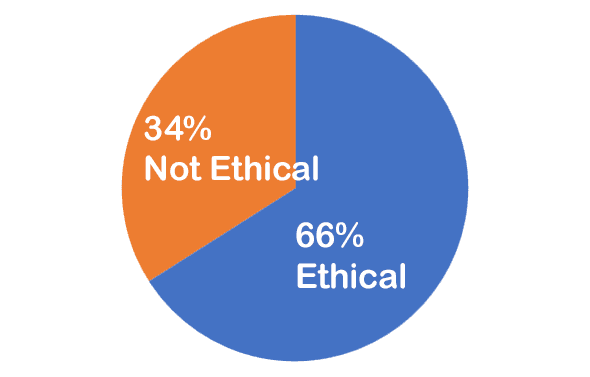
Here is the result of our survey of your peers:
Applicable NSPE Code References:
Code II.4: Engineers shall act for each employer or client as faithful agents or trustees.
Code II.4.a: Engineers shall disclose all known or potential conflicts of interest which could influence or appear to influence their judgment or the quality of their services.
Discussion
The facts in the present case raise a fundamental issue concerning the manner in which engineers may properly provide professional services and specify products from companies which they control, in light of the language contained in the NSPE Code of Ethics Code II.4.a., which requires engineers to disclose all known or potential conflicts of interest that could influence or appear to influence their judgment or the quality of their services.
Although Engineer Alice was the President and major shareholder in a company that manufactured and sold air compression systems, clearly Engineer Alice took all necessary and reasonable steps to disclose all potential conflicts of interest in order to avoid any appearance of a conflict. By immediately disclosing the fact that she had a major interest in an air compression manufacturing company, by suggesting the name of four other alternative manufacturers, and by raising the issue before it surfaces as a result of possible appearances, Engineer Alice has acted consistently with the Code. Unlike the previous provisions of the Code that required the engineer to “avoid” conflicts of interest, the current code acknowledges that conflicts do arise and imposes upon the engineer the responsibility to take all reasonable steps to notify and advise the client – leaving it up to the client whether to proceed with the services of the engineer. It is the Board’s view that Engineer Alice’s conduct was in keeping with Code provision that engineers must disclose all known conflicts of interest which could influence or appear to influence their judgment or the quality of their services.
The Ethical Review Board’s Conclusion

It would not be a conflict of interest, and therefore it would be ethical for Engineer Alice to prepare a set of specifications for an air compression system and then have her company manufacture the air compression system under the facts.
BOARD OF ETHICAL REVIEW
Lorry T. Bannes, P.E., James G. Fuller, P.E., Donald L. Hiatte, P.E., Joe Paul Jones, P.E., Paul E. Pritzker, P.E., Richard Simberg, P.E., C. Allen Wortley, P.E., Chairman
Note – In regard to the question of application of the Code to corporations vis-a-vis real persons, business form or type should not negate nor influence conformance of individuals to the Code. The Code deals with professional services, which services must be performed by real persons. Real persons in turn establish and implement policies within business structures. The Code is clearly written to apply to the Engineer and it is incumbent on a member of NSPE to endeavor to live up to its provisions. This applies to all pertinent sections of the Code. This opinion is based on data submitted to the Board of Ethical Review and does not necessarily represent all of the pertinent facts when applied to a specific case. This opinion is for educational purposes only and should not be construed as expressing any opinion on the ethics of specific individuals. This opinion may be reprinted without further permission, provided that this statement is included before or after the text of the case.




 1431 Graham Drive, Suite 265
 support@noonpi.com

 Hi! I’m Abby, your virtual assistant.
I do not think that it would be a conflict of interest for the engineer Alice to include her own company, since she prepared “generic” specifications and she also provided a list of different manufacturers for bidding purposes without showing intent to “persuade” or force the firm to use the product of her company.
I feel that there wasn’t enough information to determine if it was ethical or not. If the project is publicly funded and opened to bidding, I would feel that it would be unethical to have Alice involved in the project outside of writing the specifications. If the project is privately funded and Alice disclosed the possibility for a conflict of interest, then I would feel that it would be ethical for Alice to be further involved with project.
While it may be ethical in a pure reading of the code, we were always told that you have to view the situation from outside parties, other potential bidders. While the engineering firm and Alice feel it’s a level playing field, her competitors in the bidding looking inform the outside may not, and even with a generic spec, Alice’s firm will have some advantage. This may suppress good bidding results by having otherwise capable firms decline to propose, or play some havoc with proposal prices or terms.
You can almost guarantee a challenge on the award if Alice’s firm gets the contract, which will slow or stop the award until settled, costing time, money, and progress. Owners don’t want to be placed in these foreseeable situations.
When faced with similar situations in our practice, we told folks you have to choose: help write a fair, generic spec OR be eligible to propose on the work in equal competition. You can’t do both.
While it may be considered ethical under the interpretation of the rules, Engineer Alice was right to call this a potential conflict of interest. Her competitors will be sure to shout “foul” if her company provides the equipment for a specification she wrote. Think about how the media sound bite will sound because of the appearance of conflict, whether disclosed or not.
I do not think it is as clear cut as stated above; NSPE Section III.5a states that an engineer should not accept financial or other considerations from equipment suppliers and in this case, the engineer IS the equipment supplier. Yes, Engineer Alice did not include her company in the specification, but she clearly made known her company does this type of work. Also, by writing the specification, Engineer Alice could include provisions that she knows only her equipment is capable of and not her competitors. This could be considered improper or questionable methods violating NSPE Section III.6
I agree that there is insufficient information provided. We are left to speculate why the firm wanted to talk to Engineer Alice’s company. Did the other firms have an opportunity to bid on the work? If so, did all of them choose to not compete? If that is so, why? The answers to these types of questions are critical for accurately assessing if there was a conflict of interest, whether real or perceived.
You all missed that the client did not actually express they intended to bid out the air compression system, they just wanted specs. Alice prepared the requested generic specifications and alternative manufacturers so that the package could be used for bidding. Alice made it known it would be a conflict of interest if her company were to bid on the project, but she built such a rapport with the client with the specs and her honesty the client decided to meet with her company to sole source the compression system. She simply did a thorough job, impressed the client, and held up the code.
More broken records here than letting a bull in a vinyl shop.
“without showing intent to “persuade” or force”… Alice has appropriately disclosed her *potential* conflict. She can sell what she determines to be best for the Owner’s criteria. It shouldn’t be unsettling to acknowledge she knows her product extensively, where to apply/not apply it, how to maintain it and by whom, where to source parts, how to control it, etc.
“If the project is publicly funded and opened to bidding, I would feel”… Such feelings could impair Alice’s ability to negotiate with a willing public buyer. Sole sourcing exists and can be perfectly legal and appropriate. Homework required though.
“we were always told that you have to view the situation from outside parties, other potential bidders”… What if the Alice and her sales rep create value that leaves the Owner no longer interested in other bidders? Or, merely leaves the Owner approving Alice’s firm as BOD in lieu of the generic spec? Are we optimizing for happy Owners or happy bidders?
“Think about how the media sound bite will sound”… like… “Breaking: Firm buys stuff they want from supplier they want. Live carnage at 6pm.”
For some world views herein, Alice should refuse compensation from her employer, conceal the solutions she knows best, and eliminate any unique product feature specification for fear that the collective herd of competition feel left out. If I’m the firm, you’ve gained nothing for me.
Spot on, Jennifer.
Seek some Design-Build exposure, folks. Learn what happy Owners look and sound like, what operating outside of the liability gap feels like, and that competition can be accretive, but certainly not prerequisite, to success.
Broken records galore.
“without showing intent to “persuade” or force”… Alice has appropriately disclosed her *potential* conflict. She can sell what she determines to be best for the Owner’s criteria. It shouldn’t be unsettling to acknowledge she knows her product extensively, where to apply/not apply it, how to maintain it and by whom, where to source parts, how to control it, etc.
“If the project is publicly funded and opened to bidding, I would feel”… Such feelings could impair Alice’s ability to negotiate with a willing public buyer. Sole sourcing exists and can be perfectly legal and appropriate. Homework required though.
“we were always told…” What if the Alice and her sales rep create value that leaves the Owner no longer interested in other bidders? Or, merely leaves the Owner approving Alice’s firm as BOD in lieu of the generic spec? Are we optimizing for happy Owners or happy bidders?
“Think about how the media sound bite will sound”… like… “Breaking: Firm buys stuff they want from supplier they want. Live carnage at 6pm.”
For some world views herein, Alice should refuse compensation from her employer, conceal the solutions she knows best, and eliminate any unique product feature specification for fear that the collective herd of competition feel left out. If I’m the firm, you’ve gained nothing for me.
Spot on, Jennifer.
Seek some Design-Build exposure, folks. Learn what happy Owners look and sound like, what operating outside of the liability gap feels like, and that competition can be accretive, but certainly not prerequisite, to success.
Alice should send another engineer from her company with the salesman, thus bypassing
I think she bent over backwards to act ethically and wrote to avoid favoring her own products. Note particularly: on the front end she told them that was president of a company that produced the products they wanted specified, and that she “provides the firm with four other manufacturers that prepare air compression systems for bidding purposes, and Engineer Alice did not include her company as one of the four specified manufacturers.” I have seen this played out in the other direction where a weight limit was given for a component along with dimensional limits and other needed properties. Since the component’s weight was insignificant to its purpose I looked for the why. It seems that there was an equivalent product that met all other requirements but was slightly heavier than this weight limit. This alternative was also simpler and more rugged and would have been the contractor’s choice if not prohibited by this weight limit. Seems that the original spec writer had an interest in the company producing this lower weight component. That line disappeared from the next issue of this specification.