

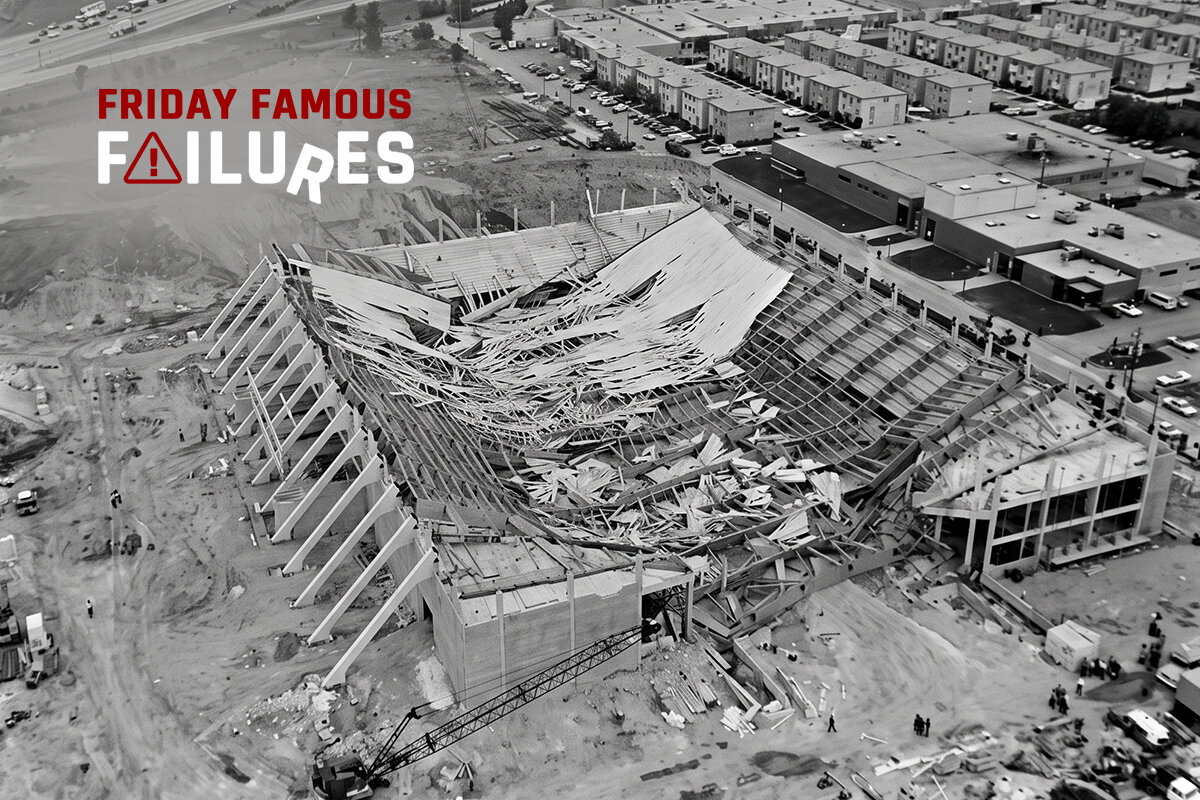
Date: August 13, 1979
Location: Rosemont, Illinois
Facility: Rosemont Horizon Arena, now Allstate Arena
Outcome: Five construction workers killed, 16 injured
Primary failure mechanism: Collapse of an unfinished timber roof system during construction
On the morning of August 13, 1979, the roof of the unfinished Rosemont Horizon Arena collapsed while construction workers were still on it. The arena, located in Rosemont, Illinois, near Chicago’s O’Hare International Airport, was intended to become a major indoor sports and entertainment venue. Instead, before it ever opened to the public, the project became a fatal construction failure.
Five workers were killed and 16 others were injured. The collapse occurred not during a packed concert or a sporting event, but during erection of the building itself. That distinction is important. Many structural systems are most vulnerable before they are complete. Members that will eventually work together as a stable three-dimensional system may be unstable, under-connected, or dependent on temporary support during construction.
For professional engineers, the Rosemont Horizon collapse is a reminder that construction sequencing is not separate from structural design. A roof that will be safe when complete may be dangerous while it is only partly connected, partly braced, or partly loaded.
A Large Roof in a Demanding Setting
The Rosemont Horizon was designed as a large-span arena with a timber roof system. One reported reason for the timber roof was acoustic performance: the building was near O’Hare, and the roof was intended to help muffle aircraft noise. The finished arena would eventually open in 1980 and serve for decades as a major Chicago-area venue.
But in August 1979, the roof was not a completed structure. It was an assembly in progress. The framing system depended on large members, bolted connections, bracing, and the progressive development of a load path. During erection, workers and contractors had to rely on temporary stability, partial connections, and construction sequencing until the permanent system could act as intended.
That temporary condition is often where construction failures occur. The final design may assume that connections, diaphragms, bracing elements, and load-sharing behavior are all present. During erection, some of those assumptions may not yet be true.
What Caused the Failure?
The reported cause centered on incomplete and inadequate roof connections during construction. Later summaries state that many required girder-connection bolts were missing, and that additional bolts were not properly fastened. One reported account states that of 944 girder bolts required for the connections, 500 had not been installed and another 106 were not properly fastened.
Those numbers should be confirmed against the original investigation records before publication, but the engineering lesson is clear: a connection that is assumed in the structural model does not exist in the field until it is installed, tightened, inspected, and capable of performing its intended function.
In a large roof system, bolted connections do more than hold pieces in place. They transfer axial forces, shear forces, bending effects, diaphragm forces, and bracing loads. They also help the partially completed structure resist construction loads and environmental loads before the final system is complete. Missing or loose bolts can change the behavior of the entire assembly.
A large-span roof is especially sensitive to this problem because the structure may rely on system action. Individual members may not be able to stand safely without the intended connections and bracing. If one area loses stiffness or load transfer capacity, load can redistribute suddenly to adjacent members and connections. In an unfinished system, that redistribution may exceed the capacity of other partially completed elements, allowing a localized problem to become a progressive collapse.
More Than Missing Bolts
It would be too simple to describe the Rosemont Horizon collapse only as a bolt problem. Missing or improperly fastened bolts are physical defects. But the broader failure was a breakdown in construction control.
Someone had to determine which connections were required before the roof could support workers, construction loads, and environmental loads. Someone had to define the erection sequence. Someone had to determine what temporary bracing was required. Someone had to inspect critical connections before work proceeded above or around them.
Large structures do not become safe automatically as they are assembled. Safety depends on the planned transition from loose pieces to a stable system. That transition requires coordination between the engineer of record, specialty engineers, fabricators, erectors, inspectors, contractors, and site supervisors.
The Rosemont Horizon collapse illustrates how dangerous it can be when the field condition gets ahead of the completed load path. In the final structure, the roof may have been intended to act as an integrated system. During construction, however, the roof was only as reliable as the connections and bracing actually present at that moment.
Engineering Lessons
The first lesson is that temporary conditions require engineering. Construction loads, partial bracing, incomplete diaphragms, uncompleted connections, wind exposure, equipment loads, and worker access can create demands that differ significantly from final service conditions.
The second lesson is that connection completion is a life-safety issue. Bolts, welds, seats, bearing surfaces, splice plates, and fasteners are not administrative details. If they are part of the load path, they must be installed and verified before the structure is allowed to depend on them.
The third lesson is that inspection must match risk. A large-span roof under construction should have clear hold points for critical connections, bracing, and load-transfer elements. Work should not advance simply because erection is scheduled to advance.
The fourth lesson is that construction sequencing should be treated as part of the structural system. Engineers often design the completed building, but collapses frequently occur before completion. The sequence of erection can create temporary mechanisms that the final design never intended.
The fifth lesson is that communication between designers and constructors matters. The field team must understand which elements are essential to stability at each stage. The design team must understand how the structure will actually be assembled. Assumptions on either side can become dangerous.

 1431 Graham Drive, Suite 265
 support@noonpi.com


Leave A Comment