


This is the February 2026 edition of our monthly series of Ethics case studies titled What Do You Think? This series is comprised of case studies from NSPE archives, involving both real and hypothetical matters submitted by engineers, public officials and members of the public.
Your peers and the NSPE Board of Ethical Review have reviewed the facts of the case as shown below. And, here are the results.
Your opinion has been registered for the February 2026 edition of our monthly series of Ethics case studies titled What Do You Think?
Your vote is recorded as:

Want to know how your peers voted? We’ll send you an email with the poll results on February 24.
Your opinion has been registered for the February 2026 edition of our monthly series of Ethics case studies titled What Do You Think?
Your vote is recorded as:

Want to know how your peers voted? We’ll send you an email with the poll results on February 24.
A Review of the Facts
Client retains Attorney Larry in connection with litigation relating to a structural failure for a residence. Attorney Larry contacts Engineer Walter, with whom Attorney Larry has had an ongoing professional relationship for many years, to conduct a preliminary investigation. Engineer Walter agrees to provide these services, and as a favor to Attorney Larry, Engineer Walter agrees not to charge Client for the preliminary investigation.
Following a dispute between Client and Attorney Larry, Client dismisses Attorney Larry with payment for services and hires Attorney Y. Client then contacts Engineer Walter to prepare a written report and also serve as an expert witness during litigation. Engineer Walter indicates that as part of the compensation he would receive, he should be paid for the original preliminary investigation services Engineer Walter originally provided when Attorney Larry was Client’s attorney.
Was it ethical for Engineer Walter to indicate to Client that Client should pay additional compensation for the preliminary investigation services Engineer Walter originally provided when Attorney Larry was Client’s attorney?
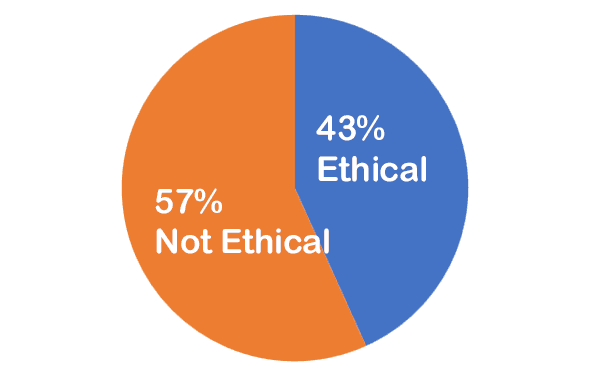
Here is the result of our survey of your peers:
Applicable NSPE Code References:
Code II.4.b: Engineers shall not accept compensation, financial or otherwise, from more than one party for services on the same project, or for services pertaining to the same project, unless the circumstances are fully disclosed and agreed to by all interested parties.
Code II.5.b: Engineers shall not offer, give, solicit, or receive, either directly or indirectly, any contribution to influence the award of a contract by public authority, or which may be reasonably construed by the public as having the effect or intent of influencing the awarding of a contract. They shall not offer any gift or other valuable consideration in order to secure work. They shall not pay a commission, percentage, or brokerage fee in order to secure work, except to a bona fide employee or bona fide established commercial or marketing agencies retained by them.
Code III.6.a: Engineers shall not request, propose, or accept a commission on a contingent basis under circumstances in which their judgment may be compromised.
Code III.7.a: Engineers in private practice shall not review the work of another engineer for the same client, except with the knowledge of such engineer, or unless the connection of such engineer with the work has been terminated.
Discussion
The facts in this case do not directly reveal the relationship between Engineer Walter and Attorney Larry, but it is reasonable to assume that Engineer Walter and Attorney Larry may have had an informal relationship, under which Attorney Larry might refer preliminary investigation and expert witness business to Engineer Walter. It is not entirely clear what the extent of this arrangement was under the facts, but there is nothing in the facts to suggest that Attorney Larry did not enjoy similar relationships with other engineers in addition to Engineer Walter.
NSPE Code of Ethics provision II.5.b. states in part that engineer “shall not pay a commission, percentage or brokerage fee in order to secure work, except to a bonafide employee or bonafide established commercial or marketing agencies retained by them”. However, in this context, the Board is not convinced that this Code provision is specifically applicable to the situation described under the facts. Without more information, it does not appear that the relationship was any different than the relationships that might exist between law firms and engineers who sometimes serve as expert witnesses prior to or during litigation. Lawyers and law firms often have lists of engineering experts that they use and on the basis of their experience may suggest to their clients for possible professional engagements. Clearly recommendations by “word of mouth” is a basic method through which engineering experts gain recognition, reputation, and notoriety within the professional community, and securing work through this method, without any indication of a formal marketing effort, does not require any careful analysis or review. Clearly there is nothing in the facts to indicate that Engineer Walter paid Attorney Larry for referring work to Engineer Walter.
Instead, the issue in this case appears to turn on the services being provided by Engineer Walter and whether Engineer Walter’s obligation was to the Client or to Attorney Larry. Assuming Engineer Walter’s obligation was to Attorney Larry, it appears that Engineer Walter would have no direct ethical duty to the Client that would obligate Engineer Walter to perform his services under the terms of the arrangement originally discussed with Attorney Larry. On the other hand, if the obligation of Engineer Walter was to the Client with Attorney Larry merely serving as the “go-between”, it would appear that Engineer Walter would have an obligation to perform his services under the terms of the arrangement originally discussed with Attorney Larry. To find that the arrangement was between Engineer Walter and the Client would also require the Board to treat this case similar to one involving a contingency relationship (See Code III.6.a.), since it appears that at least in the mind of one of the parties (Engineer Walter), Client’s payment or the forgiveness of the fee to Engineer Walter for the preliminary investigation was contingent upon at least one factor (e.g., continued use of Attorney Larry).
The NSPE Code of Ethics Code III.6.a. states that engineers “shall not request, propose, or accept a commission on a contingent basis under circumstances in which their judgment may be compromised.” This provision is intended to cause engineers to avoid cases where, for example, the payment of their fee is conditioned upon the results of their investigation. A good example of this is BER Case 91-2, involving an engineer reviewing the work of another engineer with his fee increased based upon the higher number of errors identified. There, the Board ruled the actions of the engineer were unethical. In the present case, the Board cannot identify any factors that would suggest that Engineer Walter’s judgment could have been compromised since the payment of Engineer Walter’s fee was not tied to the substantive results of his investigation as was the case in BER Case 91-2, but instead appeared to hinge on Attorney Larry’s continued involvement in this matter.
Without exploring such matters as attorney client privilege, attorney work product, and the right of any client to select the legal counsel of their choice without interference, the Board is of the view that regardless of the formal nature of the relationship between the parties, Engineer Walter, either independently or through Attorney Larry, has some type of ethical obligation to the Client, either at the outset of the relationship or soon thereafter, to make clear what the terms and conditions of their relationship would be and what impact, if any, the termination of Attorney Larry would have on the rights and responsibilities of the parties, particularly Client and Engineer Walter.
By failing to do so, Engineer Walter caused a misunderstanding with Client that could have been easily avoided through early disclosure, which should have been made in writing. In addition, it appears from the facts that Engineer Walter, by not agreeing later to provide expert testimony without additional compensation for the preliminary investigation, exacerbated this misunderstanding. Code II.4.b. states that “Engineers shall not accept compensation, financial or otherwise, from more than one party for services on the same project, or for services pertaining to the same project, unless the circumstances are fully disclosed and agreed to by all interested parties.” While engineers are clearly entitled to fair, just and reasonable compensation for their professional services, such compensation should be a reflection of the terms and conditions that the Engineer agreed to provide in full and open disclosure and negotiation as appropriate with the Client.
The Ethical Review Board’s Conclusion
It was not ethical for Engineer Walter to indicate to Client that Client should pay additional compensation for the preliminary investigation services Engineer Walter originally provided when Attorney Larry was Client’s attorney.
BOARD OF ETHICAL REVIEW
Lorry T. Bannes, P.E., James G. Fuller, P.E., Donald L. Hiatte, P.E., Joe Paul Jones, P.E., Paul E. Pritzker, P.E., Richard Simberg, P.E., C. Allen Wortley, P.E., Chairman
Note – In regard to the question of application of the Code to corporations vis-a-vis real persons, business form or type should not negate nor influence conformance of individuals to the Code. The Code deals with professional services, which services must be performed by real persons. Real persons in turn establish and implement policies within business structures. The Code is clearly written to apply to the Engineer and it is incumbent on a member of NSPE to endeavor to live up to its provisions. This applies to all pertinent sections of the Code. This opinion is based on data submitted to the Board of Ethical Review and does not necessarily represent all of the pertinent facts when applied to a specific case. This opinion is for educational purposes only and should not be construed as expressing any opinion on the ethics of specific individuals. This opinion may be reprinted without further permission, provided that this statement is included before or after the text of the case.


 1431 Graham Drive, Suite 265
 support@noonpi.com

I have zero issue with Walter being compensated for all of his work start to finish.
Walter would have been better served, however, if the cost of his written work included the need to “refresh his familiarity” with the preliminary investigation. Or, perhaps, if he adjusted his rates to account for the nuisance factor of dealing with a potentially quarrelsome client.
Client and Attorney Y are both free to pursue hiring another professional engineer if they don’t like Walter’s terms.
In engineering it is key to choose who you work with and know their reputation. The engineer entered the project with a group they had experience working with and as such they provided work based on this condition. When the The engineer had no relationship to the Client, only the Attorney did. The engineer had no contract with the Client either nor with the Attorney. The engineer was then requested by the client to continue the work with a different Attorney, the engineer at this point issued a contract for the Client’s approval.
The focus on BER Case 91-2 is taken out of context.
As for the compensation part it is odd the claim that the engineer is trying to be compensated twice when they haven’t even been compensated once. Engineers often do preliminary work before a project gets off the ground to see if it is viable, and then if the project moves forward they put a contract together and the client can either accept or reject the contract.
No good deed goes unpunished
Greetings,
– The scenario does not indicate that 「Engineer Walter」 had any agreements/contracts with the 「Client」 before 「Attorney Larry」 was dismissed; I took to understand that “Engineer Walter agrees not to charge Client for the preliminary investigation.” to be that 「Engineer Walter」 did not enter into ANY contract directly with 「Client」, there is no indication that the 「Engineer Walter」 would provide a free/complimentary service, just that he wouldn’t charge for it (indicating that a fee is appropriate for the scope of work being done).
– There is no indication that 「Attorney Larry」 paid/reimbursed 「Engineer Walter」 for his serves (or that he is on retainer); so I am not under the assumption that he was in paid by 「Attorney Larry」 either. It is not illustrated that he was compensated at all.
– Therefore, I view it as this: an Engineer, under his own volition, was permitted by the 「Client」, under merit of his connections with 「Attorney Larry」, the privilege to enter private property and analyze a structural failure of a residence. This does not mean the 「Client」 is entitled, or can claim ownership of pictures, notes, or video that 「Engineer Walter」 created, nor can he claim ownership of 「Engineer Walter」’s thoughts/opinions/conclusions. I understand there is a frustration, that people believe if someone takes a picture of your house, the homeowner has Legal Rights to that photograph, but that is not the case.
– I understand that trying to retain (or enter into contract with) 「Engineer Walter」 AFTER the investigation is done creates issues, but I don’t think it is a matter of Ethics for 「Engineer Walter」 to negotiate what services he would be providing (or seek reimbursement for labor was previously done); this is just poor business sense by the 「Client」.
Ultimately, If we were to take this to its conclusion: we would be let to contend with the following: we can approach any Forensic Engineer and ask them to prepare a written report, if they merely allude that they should be entitled to reimbursement for their research/investigation behind the ‘written report’; this would mean they are “unethical” just through merit of a casual conversation. (Remember, It was declared ‘unethical’ for him to tell the 「Client」 that he “SHOULD” be reimburse, not that he ‘MUST’ be.). By extension, I don’t know how any conversations within a negotiation can be deemed ‘ethical’…
May this be of Good Help;
⚜ Kenny Lemens, P.E. ᵂᴵ
I agree with the previous 4 opinions. I think the Engineer did nothing wrong. He told the truth; and, he had the right to negotiate the present terms for his service. There was nothing unethical about his action. I claim that he was Ethical.
Thanks for providing the example, but we were not provided with all of the information. It should have been clearly stated that the Attorney, did not disclose to the client his agreement with the Engineer and that no fee was required for the engineer, because of the arrangement/agreement the Attorney and Engineer have.
The facts provided in the example don’t make clear: (1) if the Client was charged anything for the “preliminary study” (i.e., did the attorney get paid something but not pass it on the the Engineer?) – a different kind of problem between the attorney and the engineer, and (2) was the Client told by the Attorney “I can get you an initial oral assessment for no cost by an engineer we regularly use? (i.e., Preliminary assessments are free but if you want a formal report, there will be a cost”, or (3) was the potential cost of the engineer’s written report a factor in the dispute between the Client and the Attorney,
Bottom Line – Based on the facts presented, it appears that (1) nobody was over/double charged for anything, (2) nobody got anything for free, and (3) the role/actions of the Engineer were fairly presented to all parties as events unfolded.
The client certainly could have elected to use a different engineer and Larry would have been out of luck (win some/lose sum) but I don’t see any ethics violation.
At first, I thought this should be Unethical because the original contract was between the First Lawyer and the Engineer. But I have reconsidered and believe it could be easily framed as Ethical.
True, if the Engineer had an issue with how things ended up, maybe he should go back to the first Lawyer for payment and not the Client or Second Lawyer. But when you really boil it down to the nuts and bolts, what does it matter? There are some clients that I will not charge for something and there are others that I will. That’s my prerogative and could have been this Engineer’s as well. Ultimately, the Client and Second Lawyer are entitled to hire a New Engineer if they want and are under no obligation to continue with this one. But if they contract with a Second Engineer, they will likely need to pay for a new full investigation and not be able to use what was previously done by the First Engineer. Likewise, this (First) Engineer is under no obligation to continue his services under the new team. And if he does, he should have the right to set his fee as he desires.
The problem with this scenario is not the facts, but the presentation. Seems like this would all be avoided if the Engineer had just stated, “Yes, I will work for you on this project. Here is my fee.” and include whatever is deemed appropriate.