


This is the December 2025 edition of our monthly series of Ethics case studies titled What Do You Think? This series is comprised of case studies from NSPE archives, involving both real and hypothetical matters submitted by engineers, public officials and members of the public.
Your peers and the NSPE Board of Ethical Review have reviewed the facts of the case as shown below. And, here are the results.
Your opinion has been registered for the December 2025 edition of our monthly series of Ethics case studies titled What Do You Think?
Your vote is recorded as:

Want to know how your peers voted? We’ll send you an email with the poll results on December 23.
Your opinion has been registered for the December 2025 edition of our monthly series of Ethics case studies titled What Do You Think?
Your vote is recorded as:

Want to know how your peers voted? We’ll send you an email with the poll results on December 23.
A Review of the Facts
Engineer Adam is employed by SPQ Engineering, an engineering firm in private practice involved in the design of bridges and other structures. As part of its services, SPQ Engineering uses a CAD software design product under a licensing agreement with a vendor. Although under the terms of the licensing agreement, SPQ Engineering is not permitted to use the software at more than one workstation without paying a higher licensing fee, SPQ Engineering ignores this restriction and uses the software at a number of employee workstations. Adam becomes aware of this practice and calls a “hotline” publicized in a technical publication and reports his employer’s activities.
Was it ethical for Adam to report his employer’s apparent violation of the licensing agreement on the “hotline” without first discussing his concerns with his employer?
Here is the result of our survey of your peers:
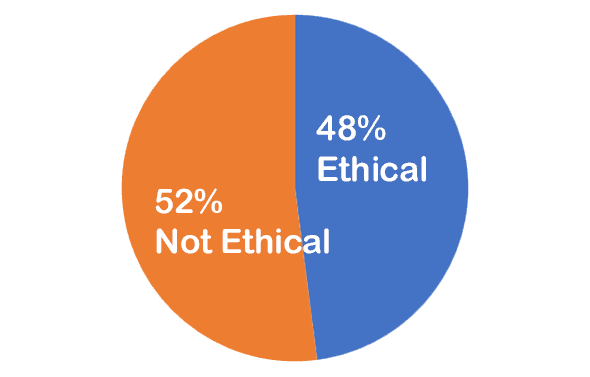
Applicable NSPE Code References:
Code II.1.c:
Engineers shall not reveal facts, data, or information without the prior consent of the client or employer except as authorized or required by law or this Code.
Code II.1.f: Engineers having knowledge of any alleged violation of this Code shall report thereon to appropriate professional bodies and, when relevant, also to public authorities, and cooperate with the proper authorities in furnishing such information or assistance as may be required.
Code II.4: Engineers shall act for each employer or client as faithful agents or trustees.
Code III.9: Engineers shall give credit for engineering work to those to whom credit is due, and will recognize the proprietary interests of others.
Discussion
The facts and circumstances involved in this case are probably most analogous to earlier Board of Ethical Review cases dealing with the issue of whistleblowing.
Over the years, the Board has considered cases relating to the issue of whistleblowing. The first, BER Case No. 82-5, involved the issue of whether an engineer had an ethical obligation or an ethical right to continue his efforts to secure a change in the policy of his employer or to report his concerns to the proper authority. The case related to an engineer, employed by a large industrial employer, who, after observing that certain subcontractor plan submissions were inadequate, notified his employer of the problem. Following several notifications to the employer, which were ignored, the engineer became insistent regarding the problem, with the result that the employer placed a critical memo in the engineer’s file and ultimately placed the engineer on probation and at risk for possible termination.
After reviewing earlier BER cases and appropriate NSPE Code provisions, the Board noted that the facts before it did not relate to a danger to the public health and safety, but were premised upon a claim of unsatisfactory plans and the unjustified expenditure of public funds. The Board concluded that in the type of situation presented in Case No. 82-5, the ethical duty or right of the engineer becomes a matter of personal conscience. The Board was not willing to make a blanket statement that there is an ethical duty in these kinds of situations for the engineer to continue his campaign within the company and make the issue one for public discussion. Said the Board, “the NSPE Code only requires that the engineer withdraw from a project and report to proper authorities when the circumstances involve endangerment of the public, health, safety, and welfare.”
In Case No. 88-6, which involved a city engineer who learned of wastewater ponds overflowing into a river, the Board, in reviewing the reasoning in Case No. 82-5, concluded that the facts involved a danger “to the public health and safety—the contamination of a community water supply.” On that basis, the Board, tracing its rationale in Case No. 82-5, noted that where an engineer determines that a case may involve a danger to the public safety, the engineer has not merely an “ethical right” but has an “ethical obligation” to report the matter to the proper authorities and withdraw from further service on the project.
Importantly, the Board acknowledged that it is difficult to say exactly at what point the engineer should have reported her concerns to the appropriate authorities. However, it was suggested that such reporting could have occurred when the engineer was reasonably certain that no action would be taken concerning her recommendations and that, in her professional judgment, a probable danger to the public health and safety existed.
We believe these two cases are instructive and relevant to the matter presently before the Board, for at least two significant reasons. First, the two cases draw a clear distinction between those matters that involve possible apparent improprieties and those that involve a probable or imminent danger to the public health and safety. Although not stated directly in either earlier case, adding further support to this basic principle is the fact that the language in Code II.1.f. is within the Rule of Practice section specifically relating to the engineer’s paramount obligation to protect the public health and safety.
Second, the circumstances involved in both BER Case Nos. 82-5 and 88-6 appear to involve situations where the engineers have at least made an effort to exhaust all internal mechanisms before contemplating taking action by reporting the dangers to the proper authorities.
Under the facts in the present case, the Board concluded that the facts and circumstance are not of a character that involves any danger—direct or indirect—to the public health and safety. Instead, the facts and circumstances relate to matters of a legal nature and do not relate to engineering judgment or expertise.
Code II.4 places a basic obligation on engineers to be faithful agents and trustees in professional matters with their employers. It is the Board’s opinion that Adam’s actions in reporting his employer’s apparent violation were directly in conflict with the NSPE Code of Ethics. We are troubled that Adam did not consider other less adversarial and surreptitious alternatives. For example, Adam could have first discussed this matter with his employer, pointing out the possible damages that the violation posed to SPQ Engineering, and suggesting that SPQ Engineering confers with its legal counsel before continuing its current actions.
Instead, Adam took a course of action that could cause significant damage to SPQ Engineering and ultimately to Adam himself. One is inclined to wonder about the motivation for Adam’s actions without his first exploring other less adversarial and surreptitious alternatives, in view of the lack of any direct danger to the public health and safety. While, in the context of the facts of this case, we cannot conclude that this provision compels Adam to ignore an apparent violation of the law and the NSPE Code (See Code III.9), by the same token, Adam could have easily exercised far greater judgment and professional discretion before taking action.
The Ethical Review Board’s Conclusion
It was not ethical for Adam to report his employer’s apparent violation of the licensing agreement on the “hotline” without first discussing his concerns with his employer.
BOARD OF ETHICAL REVIEW
James G. Fuller, P.E.; William E. Norris, P.E.; Paul E. Pritzker, P.E.; Richard Simberg, P.E.; Jimmy H. Smith, P.E., Ph.D.; C. Allen Wortley, P.E.; Donald L. Hiatte, P.E., Chairman
Note – In regard to the question of application of the Code to corporations vis-a-vis real persons, business form or type should not negate nor influence conformance of individuals to the Code. The Code deals with professional services, which services must be performed by real persons. Real persons in turn establish and implement policies within business structures. The Code is clearly written to apply to the Engineer and it is incumbent on a member of NSPE to endeavor to live up to its provisions. This applies to all pertinent sections of the Code. This opinion is based on data submitted to the Board of Ethical Review and does not necessarily represent all of the pertinent facts when applied to a specific case. This opinion is for educational purposes only and should not be construed as expressing any opinion on the ethics of specific individuals. This opinion may be reprinted without further permission, provided that this statement is included before or after the text of the case.



 1431 Graham Drive, Suite 265
 support@noonpi.com

I chose ethical. I think it’s highly unlikely that one person (Adam) bringing this to the attention of mgmt. would change anything given the economic impact to the employer. He might have been concerned that bringing it to their attention would result in long term subtle effect on his career. The Board saw this as a violation of the Code of Ethics. Perhaps the verbiage of the Code shroud be visited as it sounds like apparent fraud if not involving public health/safety is acceptable or at least un-ethical.
Agreed, in particular Adam should have suggested that the matter be discussed with legal council as it may have exposed the firm to allegations of fraud and damaged the firm’s reputation .
Adam’s manager and legal counsel were already aware of the violation I’m sure, and chose to do nothing. I disagree that Adam’s behavior was unethical. If anything, Adam’s employer was unethical for putting him in the position of needing to report.
Was Adam’s reporting ethical? Absolutely!
Did SPQ Engineering violate the terms of its licensing agreement? It sure looks like it.
As presented, the case summary did not mention what steps, if any, Adam took between when he first became aware of the situation and when he called the hotline. The omission of this critical information seems common in the NSPE’s cases as presented. So we’re left with incomplete information.
That leaves us with two other questions:
1 – Was Andy obligated to report the violation?
2 – Was Andy’s reporting of the violation wise?
For the first question, I don’t see this as a mandatory-reporting situation. Andy was not obligated to report anything. He was not a signatory to any licensing agreement. He was merely an “aware party”.
For the second, we in Wisconsin might say this is where the “cheese becomes more binding”. IF Andy had discussed the apparent violation of licensing terms with his employer AND then later reported the violation to the software vendor, THEN it wouldn’t take much for Andy’s employer to connect the dots. In such a case, Andy has taken on all of the personal and career risk with no personal gain in a situation where he is not one of the signatory parties.
Admirable? Perhaps.
Will Andy sleep better at night? Again perhaps, but he may be sleeping on the street, homeless and jobless.
A better consideration might be for Andy to ask himself if SPQ Engineering is the sort of employer he really wants to work for. Is this sort of violation common at SPQ?
Similarly, he might also consider the software licensing terms. Are they fair or abusive? Remember the shrink-wrapped licensing terms we used to see 30 years ago? Taking the cellophane off the box theoretically obligated you to all sorts of ridiculous terms. The licensing agreements of today are little better and arguably worse.
Personally, I see no issue if SPQ loads the software onto multiple computers PROVIDED THAT no more than one instance of the software is active at any one time. That would seem to be fair use, and it also fits most modern “floating license” arrangements. But that wasn’t in today’s case as presented.
I voted Unethical. I think that whenever someone or a company does anything wrong in your perception, you should always check with the party that you perceive as acting incorrectly. The party’s response may make you change your mind or the party may correct the mistake. Acting purely on speculation behind one’s back is always unethical.
Also, if you speculate that your firm will react negatively to your suggestion of correcting something that is wrong, you should not be part of that firm. Staying with the firm would mean that you agree with the firm’s erroneous action and would be complicit.
Adam may be aware of the formal licensing agreement between his employer and the vendor, but it is unlikely that he is aware of all communication between his employer and the vendor. SPQ may have obtained permission to use the software in a number of workstations under verbal agreement with the vendor. In that case, going to the “hotline” may expose the firm to negative exposure. It could also create a problem for the vendor as each of its software users might demand expanded use permission.
I contend that going to your employer is unethical because you are in essence helping to cover up unlawful acts. Does anyone think that pointing this out to your employer will cause them to pay the back fees. Also, going to your employer may result in retaliation. It is clear to me that these ethics standards have nothing to do with ethics and everything to do with protecting corporations. It has been shown Time and Time again that when corporations violate the law they don’t do the right thing when an employee points it out.
It is ethical to be a whistleblower if your company is doing something outside the law without discussing it with your employer.
I chose ethical. What I think is amazing is that there are such contradicting positions on this kind of dilemma. How are our ethics so unclear?
I want more information. Based on the facts I chose non ethical. Were multiple engineers using it consistently, or was it primarily one main designer, and it was being used on some other workstations as a convenience? I have been taught not to bite the hand that feeds me.