

This is the January 2026 edition of our monthly series of Ethics case studies titled What Do You Think? This series is comprised of case studies from NSPE archives, involving both real and hypothetical matters submitted by engineers, public officials and members of the public.
Your peers and the NSPE Board of Ethical Review have reviewed the facts of the case as shown below. And, here are the results.
Your opinion has been registered for the January 2026 edition of our monthly series of Ethics case studies titled What Do You Think?
Your vote is recorded as:

Want to know how your peers voted? We’ll send you an email with the poll results on January 27.
Your opinion has been registered for the January 2026 edition of our monthly series of Ethics case studies titled What Do You Think?
Your vote is recorded as:

Want to know how your peers voted? We’ll send you an email with the poll results on January 27.
A Review of the Facts
Engineer Alex is a professional engineer with 22 years of experience. He has been employed with his current employer for seven years. During this time, Engineer Alex has helped his company develop a very successful division that recycles rubber tire scraps into flooring type mats, a product for which its customers find many uses. Engineer Alex is the sole engineer in the division, and has been focused on improving the product and the manufacturing process.
New management has taken over the company and one of the first acts of the company president, Engineer Brian, is to require each current employee to sign a confidentiality and non-solicitation agreement. Under the terms of the agreement, Engineer Alex would be required to (1) assign ownership of all patents, inventions, copyrights, and other intellectual property created during the course of employment to the company, (2) maintain confidentiality of all trade secrets and other confidential and proprietary information of the company during and after employment, (3) agree not to solicit customers or prospective customers of the company following termination of employment with the company, and (4) agree not to compete with the company or work for a competitor of the company for a period of three years.
Was it ethical for Engineer Brian to seek to obtain Engineer Alex’s signature to the confidentiality and non-solicitation agreement?
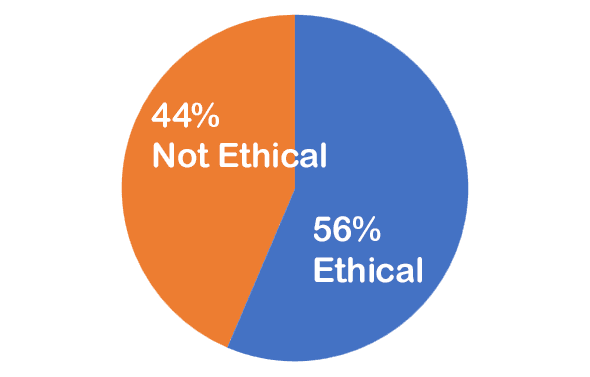
Here is the result of our survey of your peers:
Applicable NSPE Code References:
Code II.4: Engineers shall not disclose, without consent, confidential information concerning the business affairs or technical processes of any present or former client or employer, or public body on which they serve.
Code II.4.a: Engineers shall not, without the consent of all interested parties, promote or arrange for new employment or practice in connection with a specific project for which the Engineer has gained particular and specialized knowledge. Code III.7
Code III.7: Engineers shall not attempt to injure, maliciously or falsely, directly or indirectly, the professional reputation, prospects, practice, or employment of other engineers. Engineers who believe others are guilty of unethical or illegal practice shall present such information to the proper authority for action.
Discussion
The Board has had occasion to consider the issue of restrictive employment agreements in the past. These cases typically involve a balancing of the benefits, responsibilities, and obligations of both the employer and the engineer in the performance of engineering services.
In this case, the Board finds that clauses 1 and 2 are not objectionable because they are consistent with the NSPE Code of Ethics, law, and the general custom and practice within the engineering profession. Clause 3 is generally not prohibited by the NSPE Code of Ethics unless it involves confidential information concerning the business affairs or technical processes of a present or former client or employer and is done without consent. However, clause 4 would appear to be too broad because it would apply to all employed engineers in the company regardless of their tenure with the company and would be binding on the employed engineers (including Engineer Alex) for three years without limitation.
This agreement would appear to totally bar any employment with a competitor for a period of three years under any circumstances. In addition, the agreement is not bound in any way by any geographic limitation. Instead, the agreement would appear to apply to any competitor in the world. Clause 4 would, in essence, force a knowledgeable engineer to remain unemployed in his or her area of expertise or be hired by a company that does not compete with the employer, for a period of three years following termination of employment, regardless of the cause of employment termination. We believe this is unreasonable and on that basis believe that it would be unethical for Engineer Brian to seek to obtain Engineer Alex’s signature on the confidentiality and non-solicitation agreement as it is presently worded.
The Ethical Review Board’s Conclusion
It was not ethical for Engineer Brian to seek Engineer Alex’s signature to the confidentiality and non-solicitation agreement in the manner described.
BOARD OF ETHICAL REVIEW
James G. Fuller, P.E.; William E. Norris, P.E.; Paul E. Pritzker, P.E.; Richard Simberg, P.E.; Jimmy H. Smith, P.E., Ph.D.; C. Allen Wortley, P.E.; Donald L. Hiatte, P.E., Chairman
Note – In regard to the question of application of the Code to corporations vis-a-vis real persons, business form or type should not negate nor influence conformance of individuals to the Code. The Code deals with professional services, which services must be performed by real persons. Real persons in turn establish and implement policies within business structures. The Code is clearly written to apply to the Engineer and it is incumbent on a member of NSPE to endeavor to live up to its provisions. This applies to all pertinent sections of the Code. This opinion is based on data submitted to the Board of Ethical Review and does not necessarily represent all of the pertinent facts when applied to a specific case. This opinion is for educational purposes only and should not be construed as expressing any opinion on the ethics of specific individuals. This opinion may be reprinted without further permission, provided that this statement is included before or after the text of the case.




 1431 Graham Drive, Suite 265
 support@noonpi.com

Clause 1 is also pure garbage.
There’s no mention of any employee agreements existing prior to Brian taking over the company, so it seems fair to assume there are none.
Brian is now attempting to gain ownership retroactively of everything Alex has done over the course of his 22 years working for the company. What does Alex get in return? It appears to be zip, nada and squat. In order to continue his career, Alex must give up many of his personal rights, apparently for free.
Brian might just as well double-down and demand ownership of everything Alex learned since graduating high school.
It’s this sort of behavior that pretty much guarantees that Brian will be a horrible leader and person to work for. Brian has just alienated one of his key employees — one that may now be primed to leave and start a competing company. After all, Alex has the knowledge, the secret sauce, not Brian. And I’ve seen this play out elsewhere in real life.
It’s also this sort of behavior that illustrates the death of the two-way employer / employee loyalty myth.
Would the non-compete agreement be ethical if there would be adequate compensate for clauses 3 and 4?
This looks like the starting point for a broader discussion rather than something to sign immediately. As Mr. Cooper highlighted, compensation is a critical topic, and each clause should be carefully reviewed and negotiated.
For context, my father faced a similar situation with a major US manufacturer. When he was laid off, he was offered a six-month severance package with pay and benefits, but only if he agreed not to work for a competitor for several years. While six months of compensation seemed generous at first, the restriction made it extremely difficult for him to find a new job.
Personally, I would be wary of accepting any non-compete agreement unless the compensation covers the entire restriction period. It’s important to have an open conversation to ensure the terms are fair and realistic for your future career prospects.
The non-compete agreement is obviously a bad deal and Engineer Alex shouldn’t sign it, no question. But just because it’s a bad deal doesn’t mean it’s unethical for the company to ask for it. A contract like that takes advantage of the weak-willed and the desperate and is an effective way of chasing away good talent, so it’s ruthless and shortsighted, but it’s not unethical.
The question is could be worded better. It is within Brian’s right to request a signature of Alex. Instead, the question is whether or not the agreement would be in conflict with the code. Alex will sign the agreement because he will rightly infer that, if he doesn’t, he’ll be let go. If Alex breeches the agreement later on we now know that Brian has no legal standing to pursue Alex. Sidebar: Realistically, neither Brian or Alex probably know the nuances of the cited clauses before requesting the signature.
The Ethics Board was incorrect.
The Board is asserting that three years is unreasonable, apparently arbitrarily. Is the more-common two years not unreasonable and therefore ethical? Board discussion addresses whether each clause is objectionable based on “NSPE Code of Ethics, law, and general custom and practice…” Interesting choice to make a statement of finding regarding law. The Engineering Licensing Board (and state Bar!) are fairly clear about that subject.
Full wording and lack of agreement geographical details might not be enforceable in court, but that is a legal matter about a contractual agreement made between two parties, not an ethical question. See paragraph above. There is no information presented to frame the company’s situation and rationale for making the request.
Discussion states clause 4 would appear to broadly apply to all employed engineers in the company. Yet it was stated Alex is the sole engineer in the division, with no further information about the company, other divisions, its products or staff, leaving open for assumption that this company has no other engineers and does not fit within “general custom and practice within the engineering profession”. This manufacturing business nor its sole engineer are “general custom” in the profession for NSPE to even consider.
An employee has the right to decide agreement terms are unfair to their situation and find alternate employment. Many other terms of employment are weighed in such decisions; is it unethical for an employer to offer zero vacation days? Free market drives the nature of these “agreements”, not an group of non-lawyers opining about what is “unfair” or “beyond reason”. The company was taking steps to protect their business, not maliciously or falsely injure the engineer. The engineer crossed out terms to modify the agreement in his favor, same as he could have disagreed with all clauses and decided to resign.
No facts were presented as to importance of the engineer competing towards viability of the company’s ability to continue operations. Based on the description of the business, one could infer that the material supply chain of tires and the subsequent product is unusually specific and relies on the competitive situation, processes, details of supplier operations, contacts, volume of available raw material, infrastructure condition and debt burden, perhaps as sole manufacturer in the region to practicably stay profitable. Executive and sales non-compete agreements are absolutely enforceable where facts can be shown that the business suffers harm from breach of the CONTRACT.
Another claim by the Board is the agreement is in direct violation of Section III.7 based on employer injuring the engineer. Two parties entered an agreement, a legal contract. Board again misunderstands that the engineer cannot injured by the party he has entered agreement with. This line of reason also reinforces the notion that employer was not operating with malice, since he accepted the agreement as revised!
I knew an engineer that presented a similar document to his entire firm after years of service from all of the employees. It was the same owner / manager rather than a new owner as in this presented case. In this owner’s non-compete document, each employee agreed that they could be prosecuted if they were to work for another company that did work with any “current or future” client of this owner’s firm.
Can you imagine? Any future client? What compensation did this owner offer the employees for giving up their future employment options? They received a substantial increase in their health insurance costs. The smart and talented employees left without signing. The owner was left with only two types of employees: (1) Those not wise enough to see how damaging the document was and (2) those who were so desperate to have a job that they would sign anything put in front of them. In the long run, the owner was the one that lost out because this owner lost the best employees there.
I marked this particular case as “ethical” because I felt that Brian had the right to ask Alex to sign the document just as Alex had the right to refuse. Employers like Brian don’t deserve to have employees like Alex.
In short, I agree with Mr. DeZago and in length, I agree with Mr. DesRoches. I was very surprised at the Board’s decision. It could have been a sweet, negotiated deal for both parties and a seemingly long-term business relationship…or not and then Brain’s loss!
The Board appears to have actually decided the requested agreement was unreasonable, not unethical. If Engineer Brian chooses to make a short-sighted self-destructive decision, that is stupid but not unethical.